

Even with all the responsibilities of everyday life, people need to be spontaneous from time to time.
Many high schoolers are busy with sports, clubs and studying, and barely have any free time. Spontaneity can be hard to maintain as teenagers grow older and crave more control over their environment.
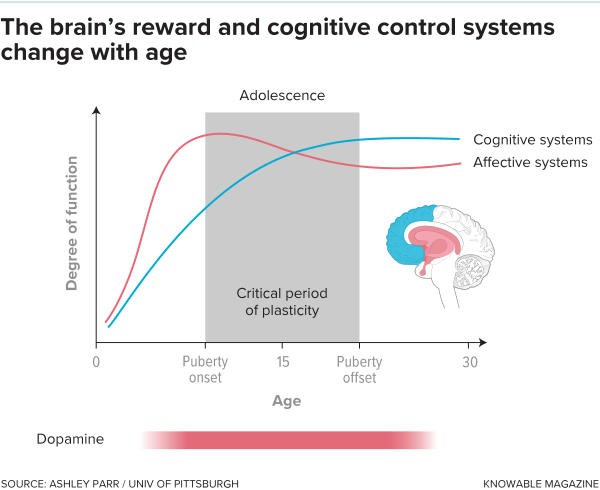
The brain, specifically the frontal cortex, is not fully developed until age 25. The cortex is responsible for executive functions, which include skills like planning and making decisions.
This fact is often used as justification to argue that teens need routine to make better decisions and improve mental health because it creates predictability. While routine can be very beneficial for mental health, so is spontaneity.
Teenagers are hypersensitive to rewards because their brains produce more dopamine than younger kids or adults. This means they have the natural urge to seek excitement and impulsivity. Spontaneity can be rewarding because when you go in with fewer expectations, you are often able to enjoy the experience more.
One form of spontaneity is play, which is unstructured activities done for entertainment. Even though play is often stereotyped as something younger kids do, it is also important for teenagers. Under the United Nations’ Convention on the Rights of the Child, anyone below the age of 18 has the fundamental right to play.
Play allows people to explore their interests and the world around them in a low-pressure environment. That type of environment makes learning feel more effortless, simple and natural than being directly taught something. Play is especially beneficial for the rapidly developing brains of teens, facilitating the ability to learn new things. Because teens have a more developed prefrontal cortex than young children, they can be more creative and logical when playing.
Leisure is an effective way for people to learn because they get to choose what is interesting or fun for them. Oftentimes, kids will put more effort into an assignment that is interesting to them rather than routine assignments. Incorporating play into the classroom allows students to be more relaxed, be more invested in the assignment, learn more and have fun in the process.
Viola Spolin, ‘The Mother of Improvisational Theater,’ wrote, “Through spontaneity we are re-formed into ourselves.”
On that note, here are some of my favorite spontaneous activities:
- Exploring random parts of my neighborhood
- Biking in the rain
- Checking in on friends through text or email
- Researching something random
- Trying science experiments with everyday things
- Singing a song and dancing along
- Jumping in leaves or puddles
- Concocting a new food and trying it
These activities are incredibly worthwhile because they make me feel fully me. Having read all this, it is time for you to be spontaneous and have some fun!