

The sun filters through the windows, minutes away from fully rising over the horizon. The hallways are blissfully empty, but the classrooms are all filled to the brim with hardworking students; yet, both places are silent as a grave. The only noise in these classrooms is the scraping of pencils against paper, as the students rack their brains and hope their studying was not entirely in vain. They sit with their head in their hands and wish they could be anywhere but in that room.
Many people believe that standardized testing should no longer be a trial for students to face in their school careers. However, standardized testing is a valuable experience that not only teaches students how to be more responsible, but also allows for teachers and the county itself to evaluate their curricula and teaching styles.
Some believe the students get no benefits from standardized testing. They believe it only serves to add extra unneeded stress in a student’s already busy life, forcing them to focus on more than just their studies. However, this extra layer of responsibility teaches students better time management. Additionally, studying and learning on their own allows them to prepare for college. College is much more unrestricted than high school is, as students have to remember what days they have classes and juggle studying, homework, clubs, and hanging out with friends on their own. Without the easy, repetitive schedule high school gives us, many students feel lost or untethered, learning to self-regulate. Having these final standardized exams forces students to study on their own, a skill they will need to have for college, and teaches them how to manage their time in order to prepare for testing as well as their clubs and homework.
Standardized tests don’t only help students, though; they also help the teachers they’re being taught by. Standardized testing is a great way to assess how well the teachers have explained their set units, and can easily be used to see which areas their students are struggling. They can use this to change their curricula in accordance to what areas were not taught as well, so future grades will have the best learning experience possible. Doctor Rachel Rubin advocates for these tests as a way to hold teachers accountable, saying, “Teacher evaluations can provide valuable feedback on instructional methods and areas for improvement, ultimately benefiting both teachers and students in the long run.” They can also use this information to accelerate or give more assistance to certain kids in the class, by seeing their individual skillsets.
Furthermore, standardized tests help on a more regional and even national scale. This can let the state see which areas need more funding for their education programs, allowing government-backed education programs like No Child Left Behind–a government program mandating reading and math standardized tests and creating penalties for schools not reaching certain testing requirements–to do the research and work they need to do to protect students. They also protect certain minority groups that are constantly sidelined by the school system by ensuring that they aren’t forgotten by the school system, EBSCO detailing that it “succeeded in raising awareness of educational disparities and improving test scores.” Standardized tests allow the county to evaluate how well their schools are doing, which ones need more funding or assistance, and whether the curricula and standards they’ve created are allowing for an environment where students can thrive and hold schools accountable for their ability to teach.
This can establish accountability within local school systems and allow the schools and areas that are less privileged to be targeted for educational aid. Victoria McDougald, chief of staff at the Thomas B. Fordham Institute, states that standardized tests “can help direct support and resources to teachers, schools, and districts in need” and can result in “[a rise in] student performance, particularly among younger children and traditionally disadvantaged populations.” Some believe that these standardized tests help perpetuate these differences, but they actually allow the counties to see where this gap is most prominent and contact the schools so they can better protect the students from discrimination or worse teaching conditions. McDougald says that these tests “show performance broken down by demographic subgroups (including race, English-learner status, and more), and can help direct support and resources to teachers, schools, and districts in need.” With the help of these tests, students who get lost in the school system can get the help they actually need to succeed in school.
Yes, it’s tiring for students to go through mandated testing every year. Yes, on the surface it seems unnecessary, exhausting, and tedious. But in reality, it has benefits that many refuse to take into account because of their bias against it, creating a narrative around standardized testing when its impacts can be felt nationwide. Standardized testing allows for teachers and the community at large to take a step back and assess the learning environment their students are growing in, as well as teaches students to take responsibility and learn on their own.
Standardized testing has become a major part of our education system, but many students and educators are beginning to question whether it truly measures students’ learning. While these tests are meant to evaluate academic performance as fairly as possible, they often create and open more problems than they actually solve.
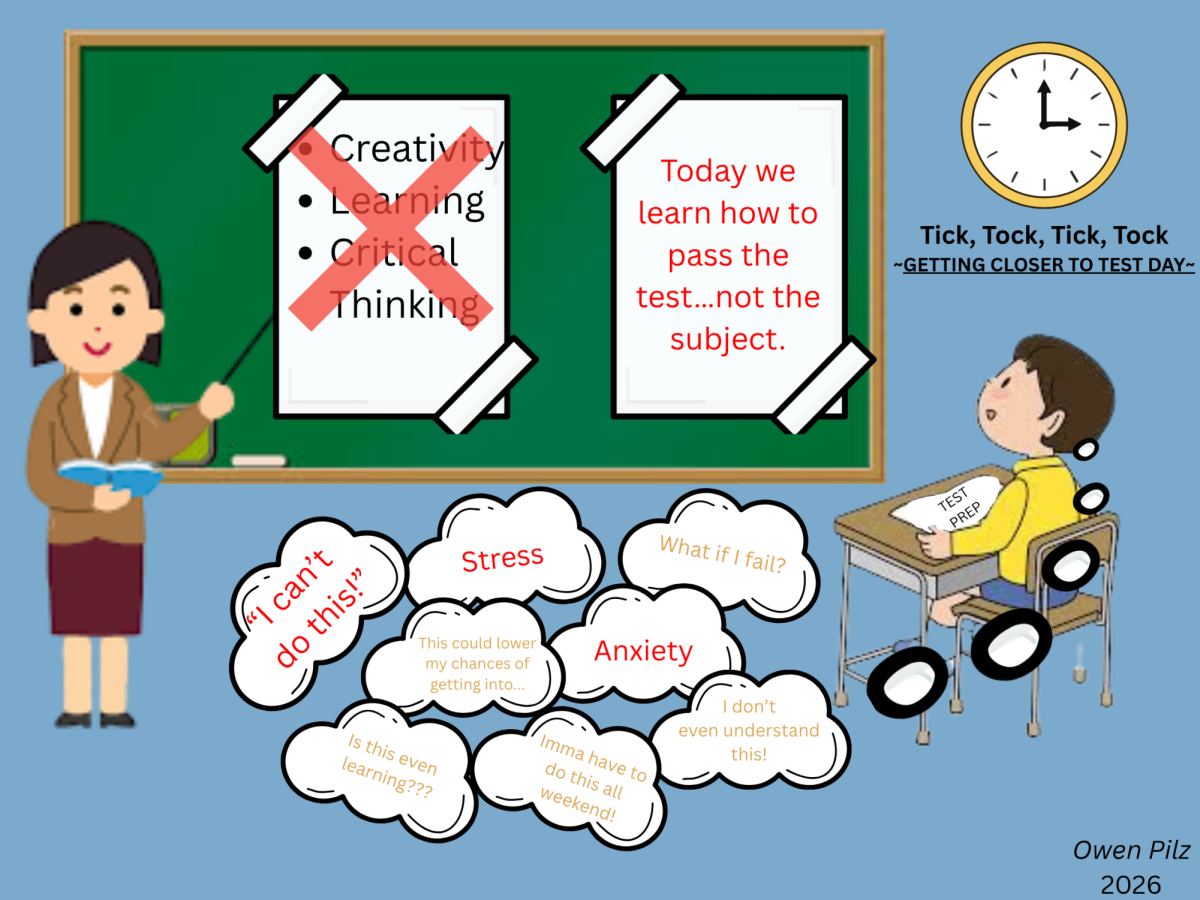
One major issue is the pressure placed on students as soon as dates get closer and closer. Standardized tests often determine important outcomes like class placement, GPA and even graduation requirements. So much is put on one single exam, and students are still meant to be paying complete attention in school, so it raises stress and anxiety levels. A student’s abilities cannot and are not meant to be tested with just one single exam that’s under a few hours. Some students naturally just perform poorly under high pressure, even when they completely understand the material.
Another concern is how standardized testing affects teaching. When schools take some weeks to focus solely on test scores, teachers may feel pressured to try their best to teach the test instead of encouraging complete understanding, creativity, and more useful skills. Lessons can become focused on memorizing the materials for the sake of the big final tests. As a result, students could learn how best to pass the exam, but never fully understand the material that goes into the test.
Additionally, knowledge is perceived differently by all students and even experts interviewed have said that knowledge can still be broken into pieces even after learned in school. “While our understanding of the brain and how people learn and think has progressed enormously, standardized tests have remained the same. Test makers still assume that knowledge can be broken into separate bits and that people learn by absorbing these individual parts”, an interview done by Fair Test. Whether we like it not, bias is present in these tests primarily because of the difference in knowledge in a test examiner versus a student taking the test.
Standardized tests can also majorly fail to account for the differences in each student’s background. Access to resources prior to learning environments, and more, can heavily affect test performances. “Many students do not have a fair opportunity to learn the material on the test because they attend poorly-funded schools with large class sizes, too many teachers without subject area certification, and inadequate books, libraries, laboratories, computers and other facilities” as researched by the IDRA, (Intercultural Development Research Association). Students who grew up in under-resourced environments with little to no access to books, certified teachers, and more, will most certainly not have the same opportunities and learning experiences that other students from well-resourced communities have.
Overall, education is meant to focus on helping students grow, explore ideas, and develop their skills as best as they can. If standardized tests keep dominating the education system, they’re risking the reduction of learning associated with just numbers and memorization, which stops students from learning as well as they can while in school. It also doesn’t set all students up for success due to their different opportunities and learning style.