

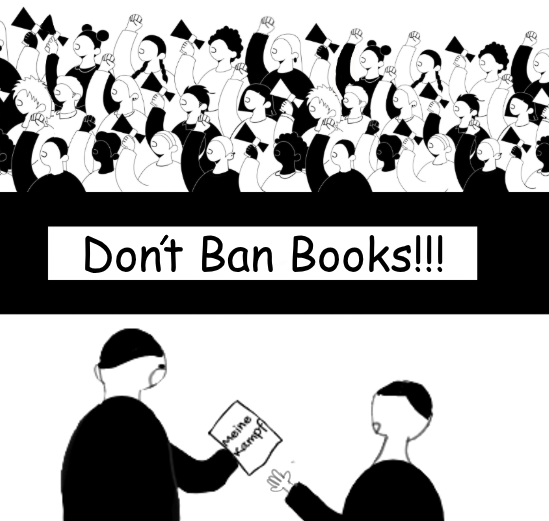
The question of whether to ban books that include certain kinds of content in schools has been a long-running debate. Those against it believe that it is unfair censorship that minimizes diversity representation. While the side vying for certain books to be banned in public schools claims it is needed to limit early exposure of students to mature or potentially traumatic topics.
The North Carolina legislature passed House Bill 636 on April 16th, 2025, which included the limiting of books with sexual activity or with vulgar content. It forced public schools to adopt a policy regarding the selection of books for school libraries. It allows community members to review recommended books and object to their selection if a book is deemed inappropriate.
Over the course of the 2024-25 school year, PEN America reported that there were 6,780 instances of book bans within 23 states and 87 public school districts. As a result of the rising prominence of book bans within schools, discussion surrounding the topic has increased, with many different opinions being shared on the matter.
When used in moderation, the banning of books within schools can be beneficial by preserving students’ minds to appropriate topics rather than topics that are improper to discuss at a young age and in a school setting.
While this matter can be helpful, it needs to be recognized that it can have harmful effects on minorities, as some books with more accurate depictions of underrecognized communities may be censored, resulting in a decline in the uniform representation of diversity.
Even so, using the term ‘ban’ when referring to the removal of books containing inappropriate content may seem misleading, because it is not as if the books are being destroyed and preventing all people from reading them. Instead, it limits the exposure of inappropriate content included in certain books to those who are not ready to consume it.
Censorship is something practiced in many areas of our lives without protest. For example, movie theatres restrict access to movies with older age ratings due to the violence of mature content. This practice is very similar to book bans, yet there is no protest or outrage against it, when both exemplify the same principles.
Some stores choose to display items near the back of the store, where the exposure is limited to customers. This doesn’t prevent customers from buying the item; it just decreases the likelihood of purchase. An example of this would be bookstores creating sections within their store based on genre and content of books, like a “mature audiences” rating on books.
Similar to book bans, these don’t outright forbid the possession of the item, but rather just don’t advertise certain items to younger demographics if they are not appropriate. It isn’t illegal to obtain a banned book in your own home, which is why many feel the term ‘ban’ seems too extreme to describe the limitation of certain books within public schools if they are deemed inappropriate.
Since 2021, over 20,000 books have been banned across 451 districts in the US. The official reasons for the bans differ for each book, from “offensive language” to “violent themes.” No matter the reason, the outrage remains the same, reflecting Americans’ distaste for the censorship of their literature.
Book bans limit the literature that citizens can access as well as their exposure to other perspectives. Most schools use soft censorship in their libraries by sectioning off mature books or requiring parental permission.
Professors’ and scholars’ opinions on censorship differ depending on their perspective. One perspective comes from Sonya Douglass, a Professor of Education Leadership at Columbia University, who believes book bans go deeper than just censorship.
“It’s a battle over the soul of the country in many ways; it’s about what we teach young people about our country, what we determine to be the truth, and what we believe should be included in the curriculum they’re receiving,” said Sonya Douglass, “There’s a lot at stake there.”
Most banned books share themes of LGBTQ and racial struggles, such as Gender Queer by Maia Kobab and The Hate U Give by Angie Thomas. Dystopian novels are commonly targeted as well; the most banned book is actually a novel titled “A Clockwork Orange,” by Anthony Burgess. It’s a classic satiric novel about a violent dystopian future run by an extremist government.
Banning books such as Burgess’ removes new, differing perspectives from the library. Instead of simply giving advisories for sensitive topics, banning books takes away a reader’s chance to learn about a topic that really connects to them.
Book bans don’t only affect the reader; the author of said book is negatively affected as well. Not only does it discourage readers from buying the book themselves, but removing it from the library also reduces the amount of income the book would make by ¼.
All things considered, the negative effects of banning books are too severe to be ignored, and it’s up to the reader to stick up for the rights of authors and themselves.