Beyond the podium: three perspectives on the two-week truce of the Winter Olympics


A downhill skier races down a hill at 80 mph, only seen as a blur of color against the powdery white of the Stelvio Slope in Bormio, Italy. Thousands of people dressed in the colors of their respective flags watch from the sidelines, hoping for a win they can bring home. In a library halfway across the world, two librarians watch with bated breath as they hope for the same thing. They aren’t in Italy, but for the two weeks of the Olympics, their library has become an unofficial hub for Olympic viewing.
Watching the games has become a fragmented experience for all; snippets of figure skating routines or highlight reels of the last hockey game watched in between assignments. Everyone watches the games differently, and behind the medals and podiums lies a deeper story than that of the athletes themselves: the way that spectators tether their lives to the spectacles of the games.
“I like turning it on because a lot of people might not have access to watch it at home, so it’s a great event with peace and sport and just unity. We need good news right now,” said Kerri-Ann Ruthven, Athens Drive media coordinator.
The quietest room at the Drive has become the most tuned-in. The Athens Drive library is well-known as a place for students to host study sessions, check out books or simply take a breather in between classes. However, for the 16 days of the Winter Olympics, while students and faculty work through book returns and computer issues, the steady sounds of blades on ice, or of cheers of national pride, can be heard in the background.
“I like [watching] the snowboarding. I like the big air. I just think it’s exciting and fascinating that somebody can do that many flips in the middle of the air and land on a skinny little surfboard,” said Ruthven.
Deciding which sport gets played on the screen while work is done becomes a common topic of discussion, especially when such a wide range of sports are offered. Sports that some people never knew existed.
“For me, definitely the luge. I know over the weekend, I was like, ‘how do you even get into this sport?’” said Shelby Urban, Athens Drive media coordinator. “If you’re living down in the South, chances are you’re not going to have the chance or opportunity to do it. It’s such a crazy sport to me; you’re going 80 miles an hour on ice, and you just steer by shifting your body weight. Like, what do they look for when they’re trying to recruit people to do this sport? How do you discover you’re good at that?”
The steady presence of the Olympic Games creates not only entertainment for Athens’ library patrons, but also a center for global pride for students who may not be able to watch the games at home.
A child of an Olympian herself, Urban has a deep understanding of the desire to watch the Olympics. Urban’s mother – Mary Lebowski – competed in the 1984 Summer Olympics as a swimmer for Team Canada; she swam the 100-meter breaststroke and the 200-meter breaststroke.
“She went to the Olympics out of high school. So she wasn’t a professional at first. And back then, there was no NIL (Name, Image, and Likeness – a person’s legal right to be paid for their personal brand), so a lot of the athletes who went to the Olympics in the eighties were amateur [athletes]. They weren’t professional athletes,” said Urban. “It’s just really interesting to see sports now with the athletes a little bit older and just who’s making money off of the sport and who’s still an amateur. I think it plays a lot into who gets to go to the Olympics and who stays home.”

While Ruthven and Urban watch from the sidelines of the media center – seeing the change from the amateur to the professional era – some students live it. For a student athlete, the triple axels of figure skaters or the 90 mph bobsled runs aren’t just a spectacle, but a glimpse into the level of discipline they strive to have.
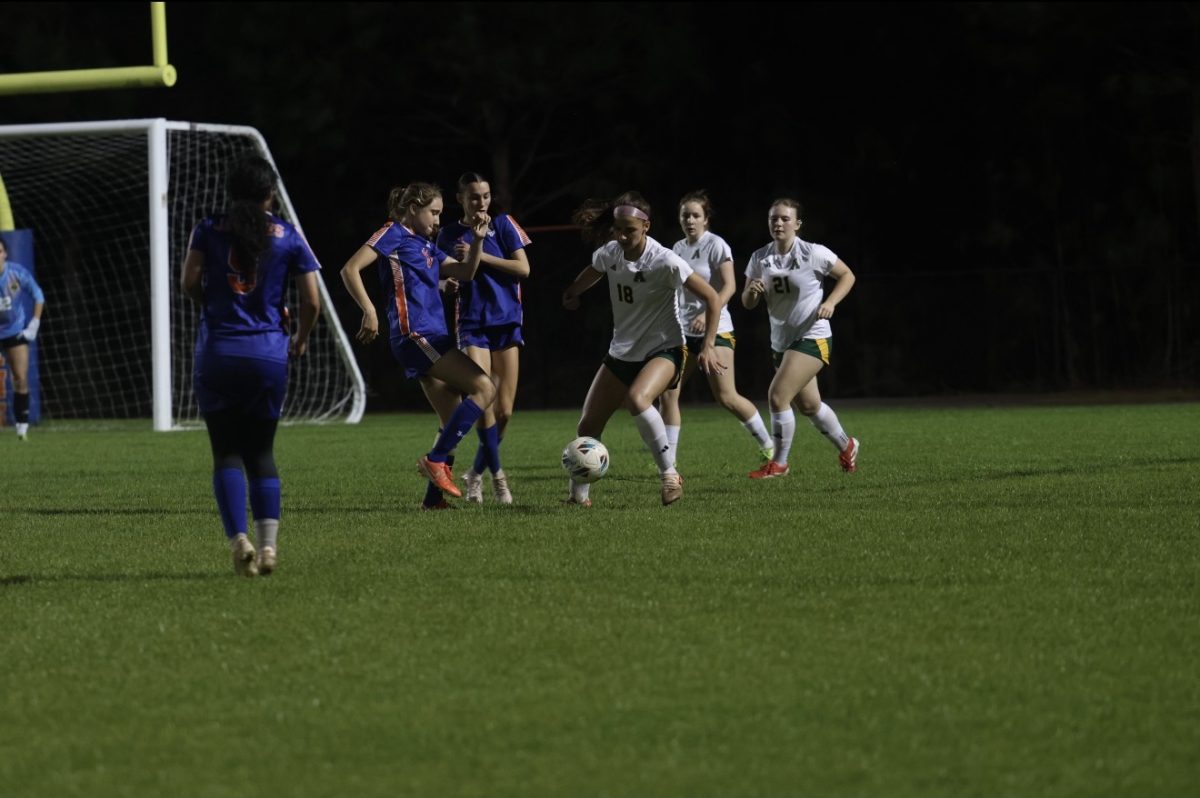
“I do think I view the Olympics from a different perspective. As someone who also works hard for their sport and someone who is going to play in college, I can understand the discipline required to work on something over and over to be able to do it,” said Rebecca Roorda, senior. “I absolutely take inspiration from these athletes as someone going to play in college. I see their hard work and know that even on their bad days, they pushed through, and it got them to the worldwide stage.”
Roorda has committed to play Division III soccer at Misericordia College in Dallas, Pennsylvania. While her sport is played on a pitch, not ice, the Winter Olympics show the future that most athletes dream of. Her commitment to collegiate athletics is already a step into a level of sport where the margin for error is paper thin. While the pressure may be on, it does not take away from the enjoyment of the Olympics as the spectacle they are.
“My favorite sports to watch are figure skating and hockey. I love the artistry that is present in figure skating as well as seeing the intricate outfits they wear,” said Roorda. “I find it intriguing how different the routines can be despite having a collection of skills they perform. I love to watch hockey on a normal basis, so watching it in the Olympics is just as fun.”
In a school as diverse as Athens Drive, the national pride of the Olympics goes further than the U.S. border. Even while bearing the stars and stripes of the United States, there comes a fascination with international competition that is only ever truly seen in these biannual games.
“I watched part of the opening ceremony, mainly the part where they were introducing the athletes from each country. I think it was cool that, despite being in different places, the opening ceremony included them all. I found it interesting to see which countries had just a couple of athletes and which countries had a lot more,” said Roorda.
Unlike previous generations, many viewers of the games follow athletes on social media, watching their lives outside of their events. Apps like TikTok and Instagram give athletes a platform to share their experiences and opinions, creating a global community with their home country, even while they represent them in Milan.
“The Olympics hold the same, if not more importance with social media and streaming. Not only can anyone watch the Olympics but they can also go on tik tok or instagram and see what the athletes are up to in the village,” said Izzy Catalano, junior. “The athletes do gear hauls and food reviews along with competing at such a high level. I will never not watch the Olympics because they are such an important event for the entire world.”
While athletes can feel immense support from the spotlight of social media and news, others can be suffocated by the pressure. One of the biggest stories of the Olympics so far has been Ilia Malinin, or the “Quad God.” The 21-year-old figure skater came to the Olympics with multiple world championships and as the gold medal favorite. It seemed every news outlet wanted to talk about him. Despite winning gold in the team event for the U.S., he finished eighth individually due to falling twice in his free skate.
“I watched the ‘Quad Gods’ performance. I think that the pressure he was under played a role, but I don’t think it was the only thing. We all have bad days, and that does not always have to do with whatever pressure we put on ourselves. Sometimes it’s simply just not our day. Ilia is an amazing skater, but sometimes the pressure does get to people, no matter what level,” said Catalano.
The new era of social media has made the Olympics more accessible for viewers and created a global connection of everyone watching – not just country-by-country – but it also created a new, uncontrollable pressure for athletes. Student athletes watching, like Roorda and Catalano, not only draw inspiration from the grit of the athletes competing, but also a warning of the stress of high-level competition.

To a casual viewer, the downhill skiing competitions are a thing of grace and speed; to the competitors, it’s a battle with the other athletes. But behind the scenes, there is a team that sees the battle of physical limitations and the calculated risks that can have devastating effects.
“Unlike casual viewers, I find it interesting to try to see where people get injured when they do. And I like to figure out what risks there are to continue with competition like Lindsey Vonn did,” said Dr. Mark Curzan, a former on-site physician for the U.S. national Ski team, in an interview with the Athens Oracle.
Curzan sees a perspective that few others can, as a doctor, he sees more than the race, but the medical protocol in motion. While the average viewer may see the podium finish, Curzan sees the recovery cycles, the lingering injuries and the mental toll of such physical demand; it’s a different kind of watching – watching for the ‘catch’ that can end an athlete’s career.
“There’s a guy, Brian Sutterer, he’s an orthopedic surgeon who puts clips together of the games when there’s a crash or a fall. He puts together thorough 15 min segments frame-by-frame of when the injuries happen. It’s fun to watch and see if I agree,” said Curzan.
For an orthopaedic doctor, there is no more interesting story than that of Lindsey Vonn. Vonn is a four time world cup champion and Olympic gold medal winner for alpine skiing. Before the 2026 Olympics – Vonn’s fifth Olympic appearance – she suffered a torn ACL, meniscus damage and bone bruising. Despite the pre-existing injuries, Vonn continued to compete. During her run on Feb. 9, Vonn crashed, resulting in multiple fractures to her tibia, ending her Olympic journey.
“Normally in the past, there’s always a moment where you break down, and you realize the severity of things and that your dreams are slipping through your fingers,” Vonn said via USA Today. “I didn’t have that this time. I’m not letting this slip through my fingers. I’m gonna do it, end of story. So I’m not letting myself go down that path. I’m not crying. My head is high, I’m standing tall, and I’m gonna do my best, and whatever the result is, that’s what it is. But never say I didn’t try.”
The clinical detachment of a doctor is inhibited for Curzan due to his position as an Olympic father. His daughter, Claire Curzan, a Raleigh-trained swimmer, competed and medaled in the 2020 Tokyo Olympics as a swimmer for Team U.S.A. He understands what it means to stand at the bottom of the hill, or the edge of the pool, watching his own child push their body to the limit to represent their country. He understands the intense pressures to perform in a four-year window that can be shut out by a hundredth of a second.

“With Claire going to the Olympics in 2020, we had to go to a watch party in Florida. She was 17 and couldn’t have parental support in the stands. Unlike now, when she’s swimming at UVA (University of Virginia), where she can look up and see us cheering for her,” said Curzan.
The Olympics are always looking for a story; it’s what keeps viewers interested. Whether the story is one of a veteran like Lindsey Vonn, or that of the gold medal favorite like Ilia Manlinin, a story is what viewers eat up, even if it’s at the expense of the athlete.
“Games are more emotional than you think, but the games turn that part off. After a poor performance, athletes sometimes wonder, ‘Do I wanna keep doing this?’ if it’s worth it, ‘do I even want to keep trying,’” said Curzan. “They (The Olympics) want to have stories. They want to tell a story about a couple who’re competing together, or why he’s (Ilia Malinin) called the ‘quad god,’ or tell the life of the speed skater who trained by doing 4-mile bike rides in Wisconsin.”

Even after the closing ceremony, after the Promethean board is turned off and put away and the “Olympic world” quiets for another two years, there will be more left behind than just a medal count. The warmth of the community hearth that the Olympic Games created will remain, student athletes will hold the reminder of grit and perseverance to their collegiate sports, and every Olympic parent will look forward to the familiar pulse of risk and resilience.
The 2026 Olympics may be fragmented across time zones and TikTok feeds, but their power remains the same. For 16 days, the Athens library wasn’t just a place to study – it was a front-row seat to the idea that, despite the miles and the mountains between viewers, they are all watching for the same thing: a reason to cheer.
“I don’t think that the Olympics are as much a thing that unites a country as much as it unites the world. Yes, the Olympics bring a country together to cheer for their country men and women, but getting to see the sportsmanship of the athletes from different countries after winning or losing is amazing and just makes me forget all the not so great things going on in the world,” said Catalano.