
Early-afternoon study sessions came to a sudden pause on Thursday, May 7, when a widespread ransomware attack forced Canvas to shut down, locking both students and administrators out of their accounts. This attack displayed error screens and messages when people attempted to log in. This shutdown comes at one of the busiest times of the year: right as school ends. With most people cramming for finals, AP tests, and graduation, the sudden digital blackout turned classrooms into chaos.
The popular online learning platform, Canvas, recently replaced Google Classroom for schools across the nation. Canvas is owned by Infrastructure, which is the same company that owns PowerSchool. Last year, PowerSchool experienced a data breach in which Social Security numbers, addresses, and other personal information were at risk. To prevent this from happening again, Infrastructure removed Canvas from portals, affecting over 9,000 schools worldwide. This put students and teachers at a standstill, as assignment deadlines approached and grades and study resources were locked. Senior Fallon Brunson was preparing for an upcoming AP test when Canvas was removed, saying that the attack made studying more difficult.
“Well, I haven’t had access to a lot of the materials, which are accustomed to what the teacher feels is important to learning,” said Brunson. “I’ve had to go online and look for resources, which is harder for me to find because they’re not as organized as my teachers have put them.”
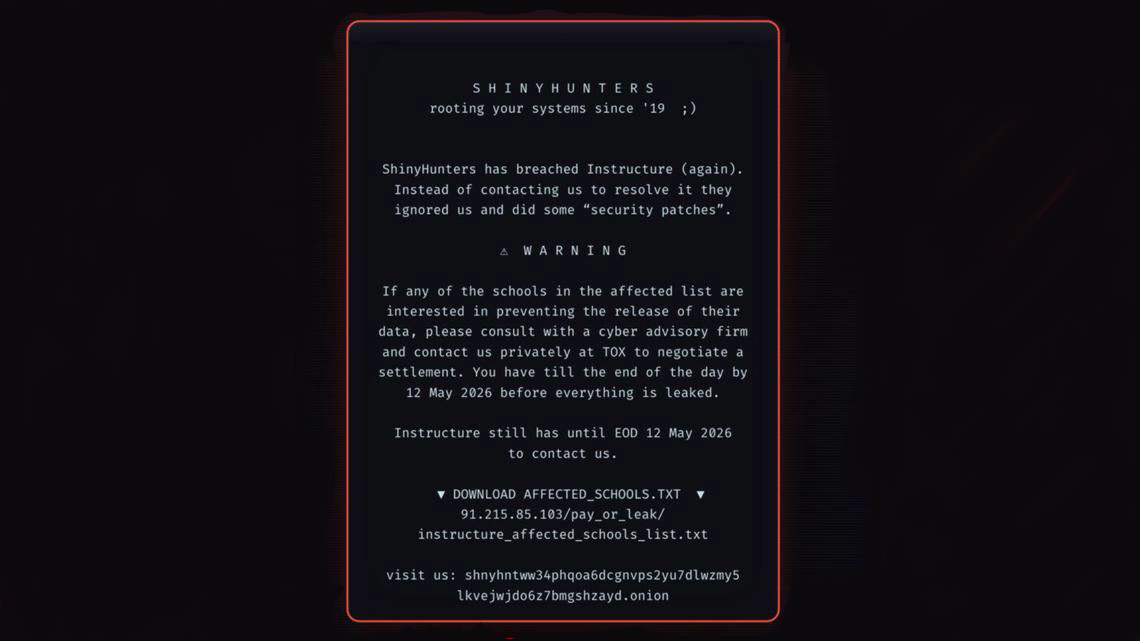
Not only did the attack affect schools, but also the lives of teachers and students. The attackers, known as the ShinyHunters, demanded a ransom to return the data and restore Canvas to normal. If the ransom was not paid by May 12, the hackers threatened to leak the 3.65 terabytes of data they stole from the attack. This is equivalent to about 500-600 hours of HD-quality video recordings, 900-1,000 HD-quality movies, and/or over 60,000 hours of audio recordings. The data compromised was only supposedly names, ID numbers, and private messages, so the panic wasn’t as large as it was for the previous attack.
“To be honest, I’m not overly worried about it because I’m not even sure what data is in there,” said Junior Lucy Whorton. “But it’s certainly not a great thought to have in the back of my mind.”
Infrastructure and the ShinyHunters settled this in court on May 11 for a publicly undisclosed amount; however, according to ABC, it is around $ 10 million. Although Canvas was brought back within a week, the damage was already done for colleges. Assistant Principal Intern Tyneka Howard, who graduated only a couple of weeks ago, feels the heavier weight of this shutdown.
“I just graduated from North Carolina Central, and we used Canvas. So, for us, [the shutdown] was like a couple of days before graduation,” said Howard. “So thinking about college campuses and what that does to students who are getting ready to graduate and turning in all those last-minute assignments… It’s bigger than just high school or middle school. This is college-level.”
After the shutdown, teachers were forced to scramble to the copying machine, and students were back to pen and pencil, resulting in delayed learning and disorganized lectures. Teachers whose grades, assignments, and updates were all on Canvas were left without resources for the coming week, leaving students in limbo. Questions surrounding grades and the looming graduation placed more stress on schools. Science teacher Lauren Latta even had a personal connection to the shutdown.
“My mother-in-law is also a teacher, and she lost access to all of her stuff because it’s all entirely in Canvas, and she was panicking,” said Latta. “I think that forcing us to use things like Canvas can make us vulnerable in some ways, like this… I’m kind of glad that I didn’t go full force into Canvas, as some of the other teachers did. I think that’s what they expected us to do at the beginning.”
In fact, like Latta, not all teachers were phased by this roadblock. Many teachers across the nation were able to make the shift almost seamless from computer to paper and back. Math teacher Christopher Remaley, one of these teachers whose class kept going, says that the reliance on technology almost invited the attack.
“I’m old school, so I have backups to everything. I have backups FOR the backups. So, I didn’t miss a beat when this happened,” said Remaley. ”I’m not gonna lean on one thing, because if something fails, you know, you should always be prepared, and that’s how I am.”
Although the scandal only lasted a week, the impact will continue to follow Infrastructure and the future of their company. Many people feel that the security measures that were put in place after one breach were not strong enough, and are calling for companies to be more aware of who can access their information.
“I don’t know how to trust the security of the data systems in schools because not only has this happened once, but it’s also happened twice,” said Brunson. “I feel unsafe due to the fact that my information can be leaked somewhere that’s supposed to keep me safe.”









ocpilz • Jun 2, 2026 at 6:14 pm
Whoever did those interviews did a WONDERFUL job!!