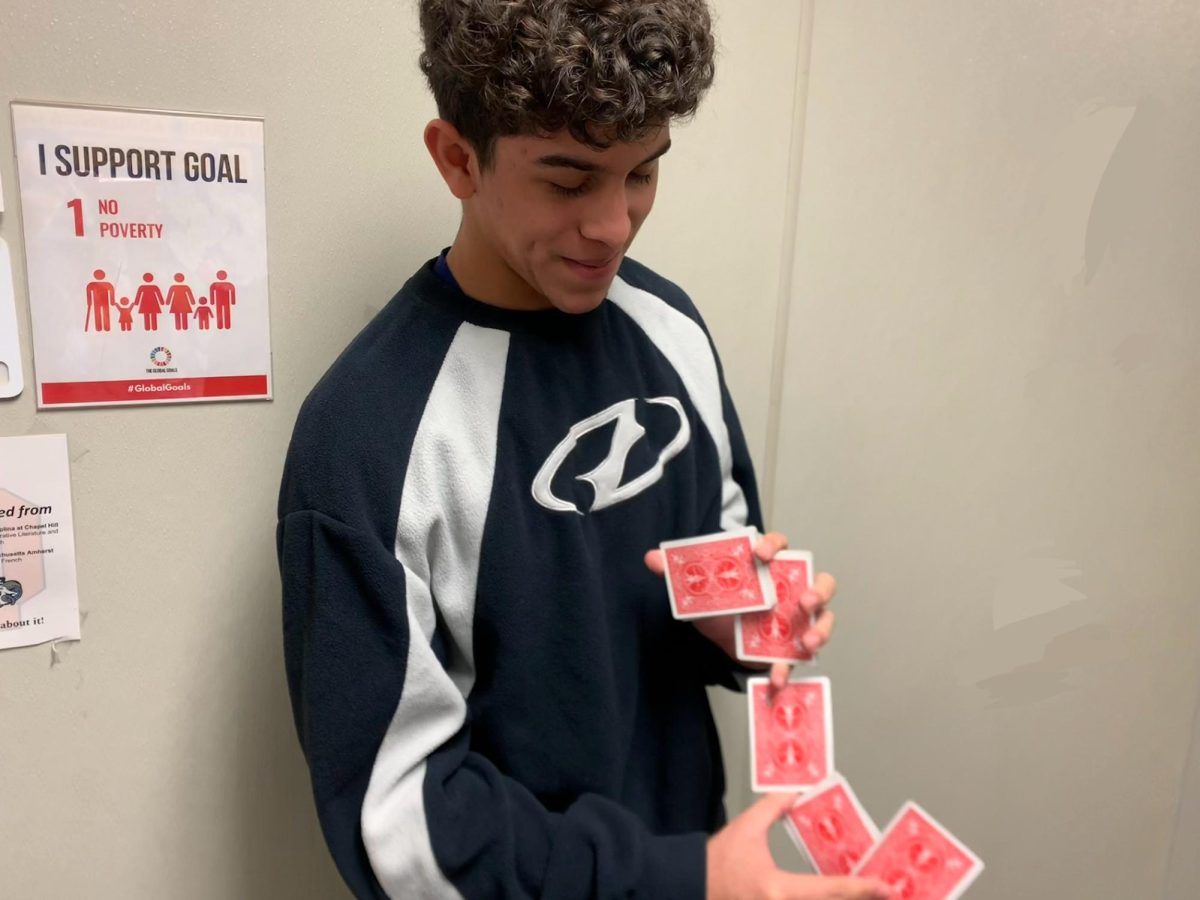
Illustrious illusions, sleight of hand, complicated card juggling–all of these are different types of magic. These tricks can be learned by anybody; anyone can learn how to make these mesmerizing feats. Junior Jesus Escalona Gutierrez is very familiar with these tricks and the art of cardistry as a whole.
“I started learning magic last year, around October. I got a deck of cards on my birthday,” said Gutierrez, “…I feel it’s really cool, but it’s not really hard.”
Most of the tricks Gutierrez does are ‘sleight of hand’ tricks. These tricks involve tricking the audience into believing an object magically appeared, when in reality it has been moved under the very noses of the viewers by the magician.
“I love the reactions of other people, the reactions they get. Like when they laugh or when they actually don’t know that it’s magic,” said Gutierrez.
Gutierrez often performs his tricks for his classmates or friends. He can always be seen with a deck of cards, whether it’s performing a mystical move or elaborately shuffling the cards.

“[He] has been spreading joy across campus and in class with this growing talent! While this is an interesting hobby on its own, it also shows how much Jesus cares about bringing joy and smiles to others,” said Renata Barsanti, the French teacher at Athens, “I am so used to asking students to put their phones away that it has been hilarious to occasionally wonder if I need to ask Jesus to put away his deck of cards.”
While cardistry may not be the hardest hobby in the world, it cannot be learned overnight. It takes practice to be able to learn how to handle cards in the first place. Then, a magician has to practice the trick they want to learn repeatedly in order to perform the trick flawlessly in front of a viewer.
“I’ve learned to see failure in a different way because when you’re starting[…] the cards [fall] out of your hands and stuff, and it actually gives me a different mentality on how to handle failure,” said Gutierrez, “Now I don’t see failure as like, you just don’t know what you’re doing, it’s more like you’re actually learning. Cause the more you do it, the less you mess up, or the cards fall.”
However, that’s not accounting for the wild card factor: the audience. While a magician can practice a trick over and over again, they will never know exactly how a person might react to their tricks.
“Sometimes I get hecklers,” said Gutierrez, “I’ll get people while I’m doing a trick, like somebody just grabs my hand and just ruins the trick[…] So, I’ve been trying to practice[…] how to handle hecklers, but that’s like the biggest struggle.”
The positives outweigh the cons, though. Compared to other hobbies, cardistry is relatively cheap to practice. The only expense needed is when the cards are initially bought, and that only ends up being about four dollars. Newbie magicians can easily learn tricks by looking up tutorials online. Almost all the tutorials are free, leaving magicians to never run out of tricks to learn.
“If you want to get into card tricks, I would recommend you to […] it’s been the best hobby that I’ve had in years,” said Gutierrez, “And I’ve done a lotta stuff, I’ve done sports, I’ve learned how to play the guitar, stuff like that but I would say cardistry is just the best one.”